Way belated, but I wanted to talk a bit about my day trip to Belfast from February, the last time I was in Ireland. It made an impact on me.
So some of my work trips to Dublin are two weeks long, which is honestly more time than I like but gives me a good solid chunk of time with my Dublin teams. Also it means I get the weekend to do touristy stuff. I gave some serious consideration to flying to Berlin for the weekend this time until deciding that I wasn’t going to have the energy for a winter Berlin trip. Instead, I spent one day taking a bus tour up to Belfast.
I used Paddywagon Tours. They were decent. The bus was comfortable and the WiFi was good; the driver/guide was a blast. Interesting hearing a Republic of Ireland native expressing dubiousness about unification, as a reminder that public opinion is not monolithic. It’s worth knowing that the itinerary is sort of variable, about which more in a bit.
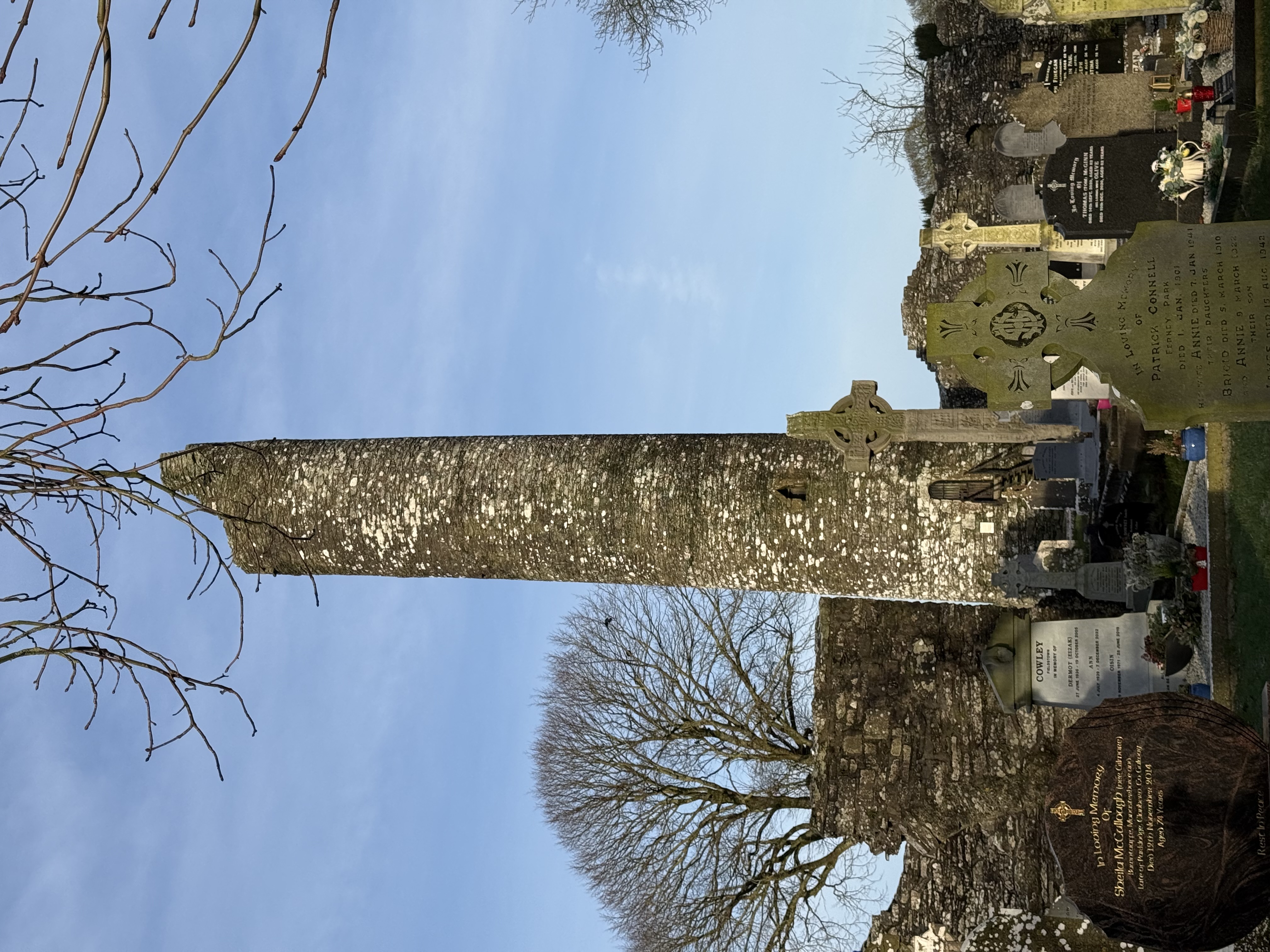
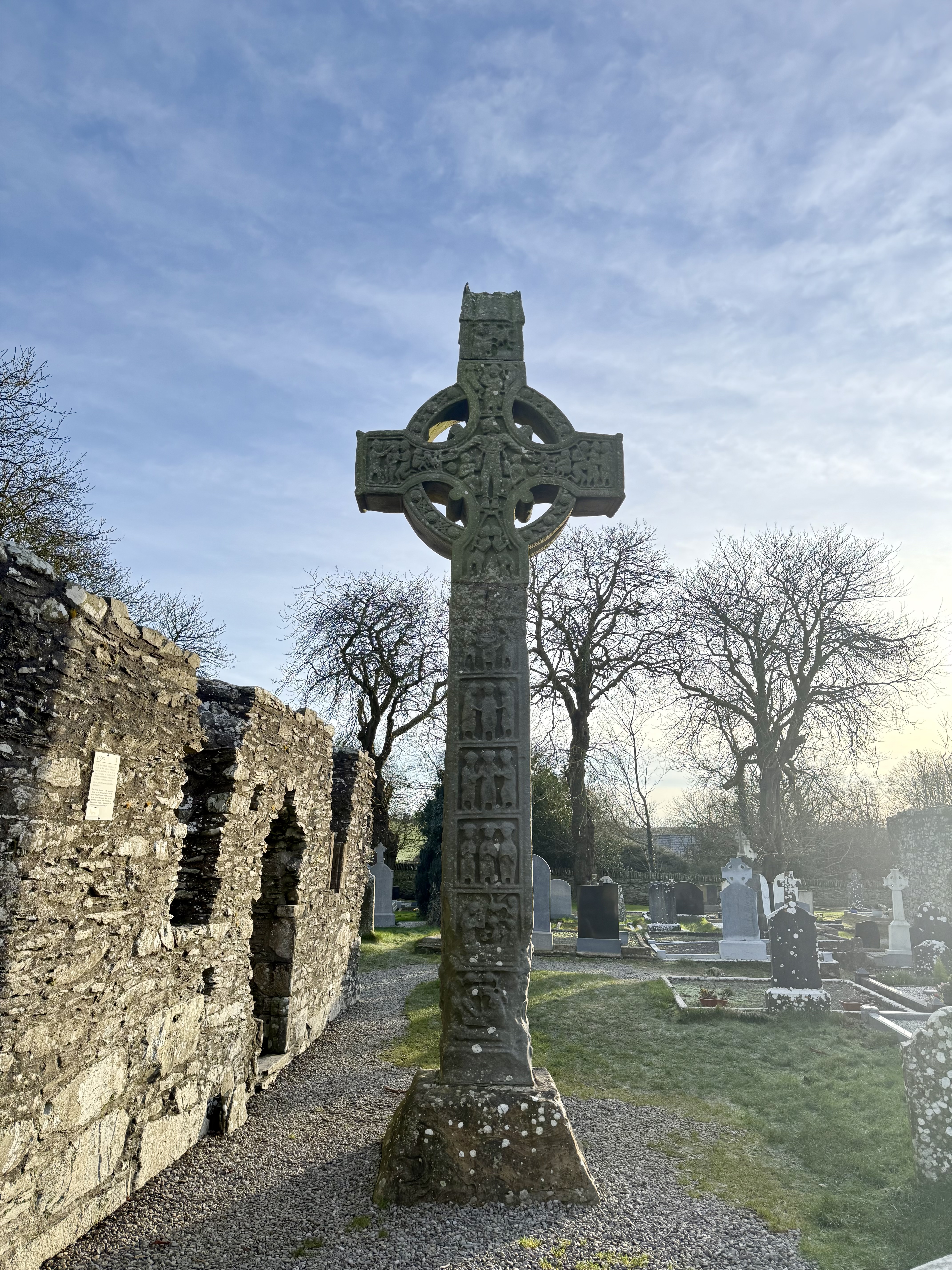
We started with the promised stop at Monasterboice. Totally worth the chilly fifteen minutes; there’s not much there but the round tower is interesting and the millennia-old Celtic crosses are impressive.
Once in Belfast, the tour dumped us at the City Hall and Donegall Square. I had really been looking forward to the promised Black Taxi tour option, because I wanted to see the core of the Troubles in… well, I wasn’t expecting a deep dive on a short tour. I figured I’d get an overview, though. Unfortunately, as the driver warned us on the trip up, Paddywagon doesn’t really have a prior arrangement with a Black Taxi tour company. Since I didn’t do my research, I hadn’t even realized that’s more of a category of tourist tours than it is a specific company. The driver kind of waved me in a direction to go see if I could find a tour company that’d satisfy me on short notice and wished me good luck.
Huh.
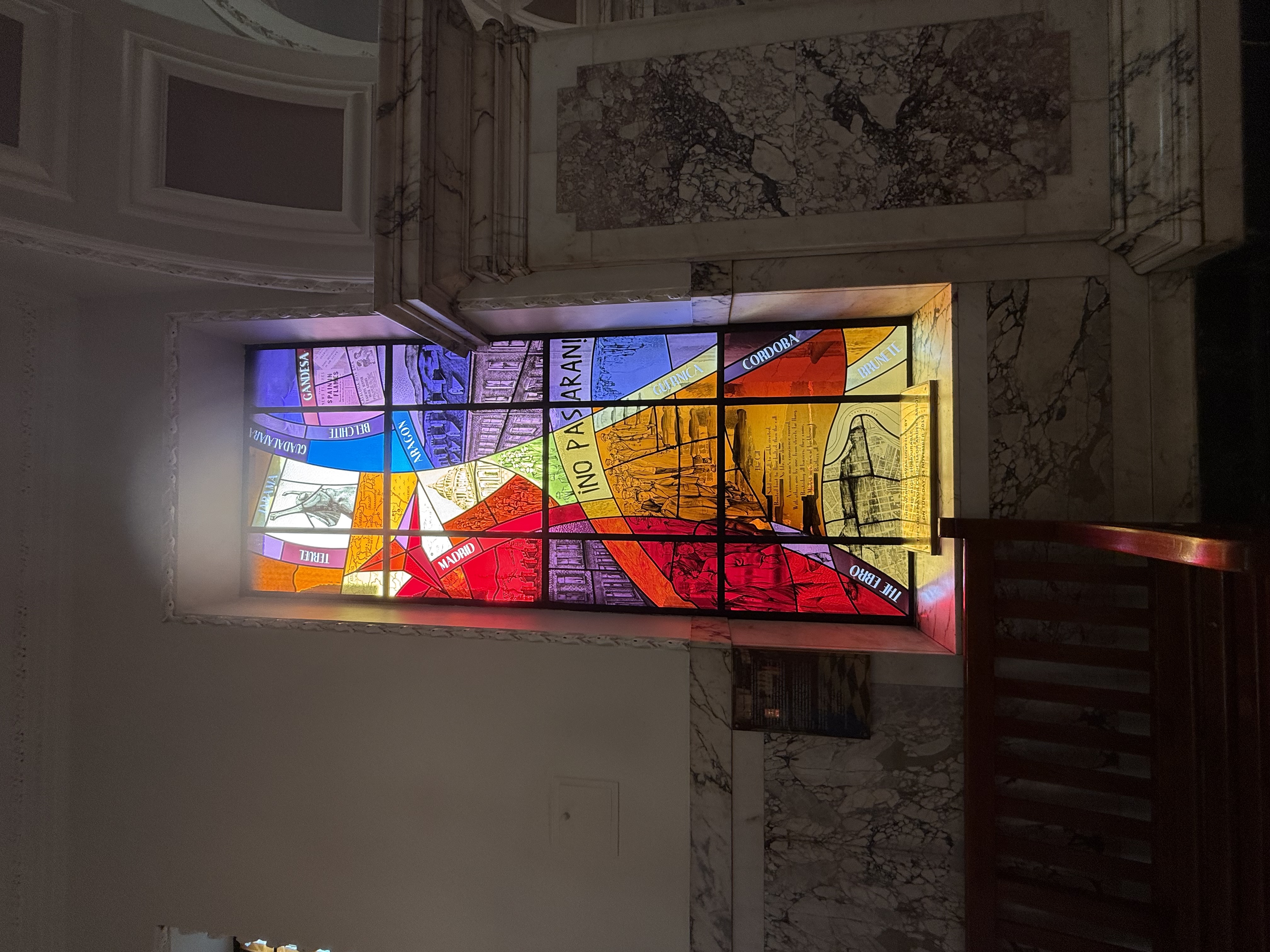
So I did a quick breeze into Belfast City Hall to use the restroom (awesome building and I wouldn’t mind spending time in the visitor exhibition). There are these cool stained glass commemorative windows, one of which confused me a bit: it’s a celebration of the Republican side of the Spanish Civil War. No Pasaran! That sort of aggressive pro-socialist anti-fascist stance is something I associate more with Irish nationalism than Northern Ireland’s unionists; turns out that Belfast unionists feel an affinity with the Spanish Republicans because the Catholic Church in Spain supported the Nationalists. You learn something every day.
I then hit up a visitor center across the square and they called around a bit to see if they could find me a Black Taxi tour, but they could not. Lesson for anyone tracing my footsteps: ignore where Paddywagon says no need to pre-book a Black Taxi tour and set up your extra excursion in advance. Also be aware that you may be short on time, because the Paddywagon bus is gonna head to the Titanic Experience museum with or without you.
So I wound up taking the path our driver recommended in the first place and getting on a Hop-on Hop-off red bus tour. Given available time, there was not gonna be any hopping off and back on for me; I had just exactly enough time for one loop around the city. And it was freezing cold, so I wound up sitting downstairs with a poor view. My own fault for not bringing gloves.
I’m glad I did it even if it was frustrating. Even just driving down Falls and Shankill Roads was an experience. We went through a couple of the gates between neighborhoods, which are closed at night to this day. I got quick looks at the murals and graffiti. We rounded a corner from one neighborhood into the next and in a pair of moments, went from seeing murals praising the Palestinian cause to murals featuring a Star of David.
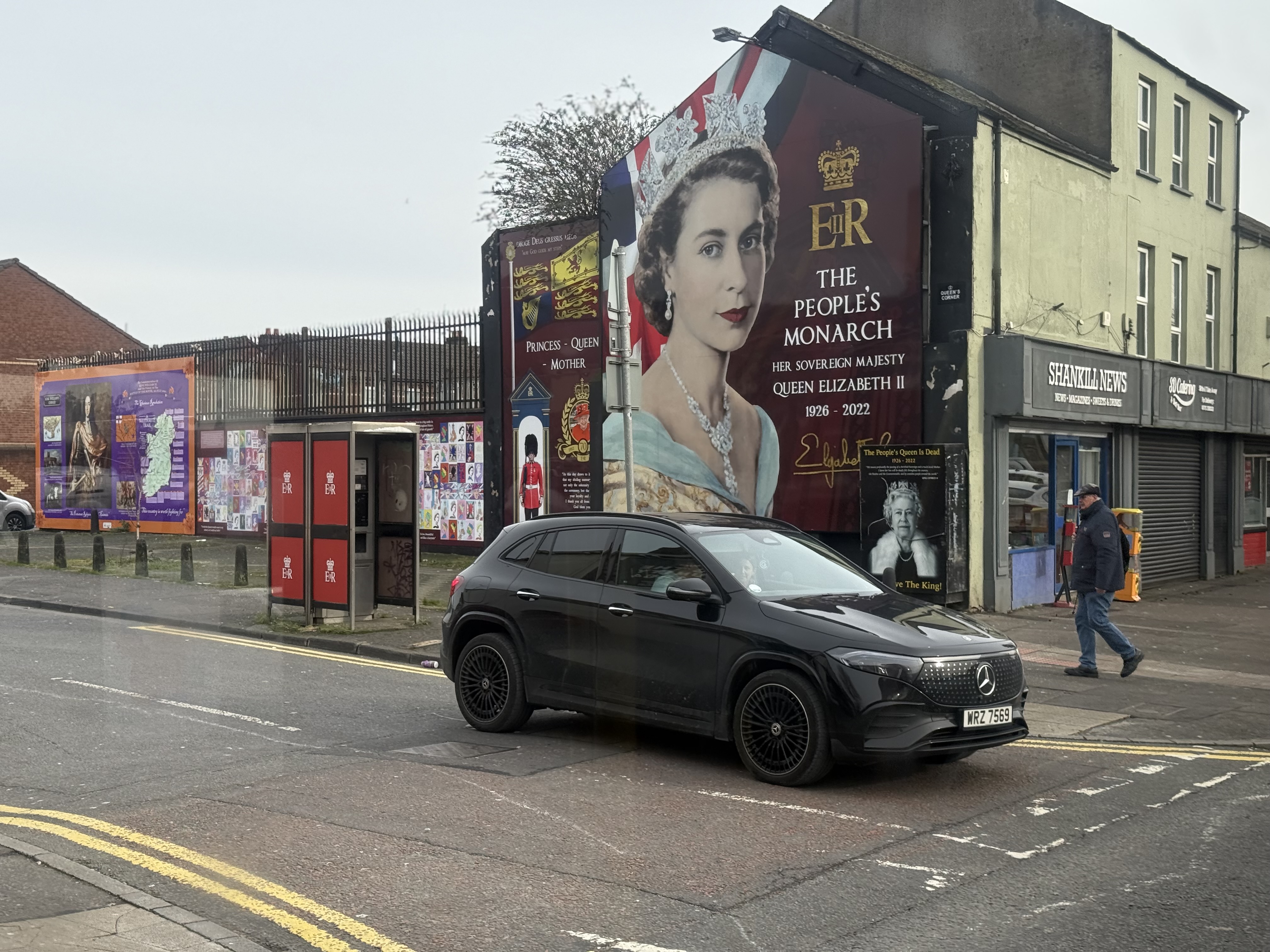
I think the most striking thing for me was on Shankill Road, driving past a mural commemorating Queen Elizabeth II. It’s pristine, even on a chilly day after rains. People put effort into keeping it that way; the British monarchy is important to that neighborhood.
I also felt the Scottish influence. Plenty of Scottish names on signs. For that matter, a couple of restaurants advertised Hong Kong cuisine. The British Empire is important to that neighborhood.
I want to go back, and I want to figure out how to visit without just gawking. There’ve got to be private tour guides who could help. I felt the weight of history from a 30 minute freezing bus tour and I would like to honor it better than that. I wish I’d arranged to go up for the weekend.
Afterwards the four or five of us on the Paddywagon tour piled back on our bus and trucked out to the Titanic Experience. Man, was that a surprise! I had it filed under cheesy tourist trap, which to be totally fair is not completely inaccurate. It also taught me a boatload about Belfast industrial history.
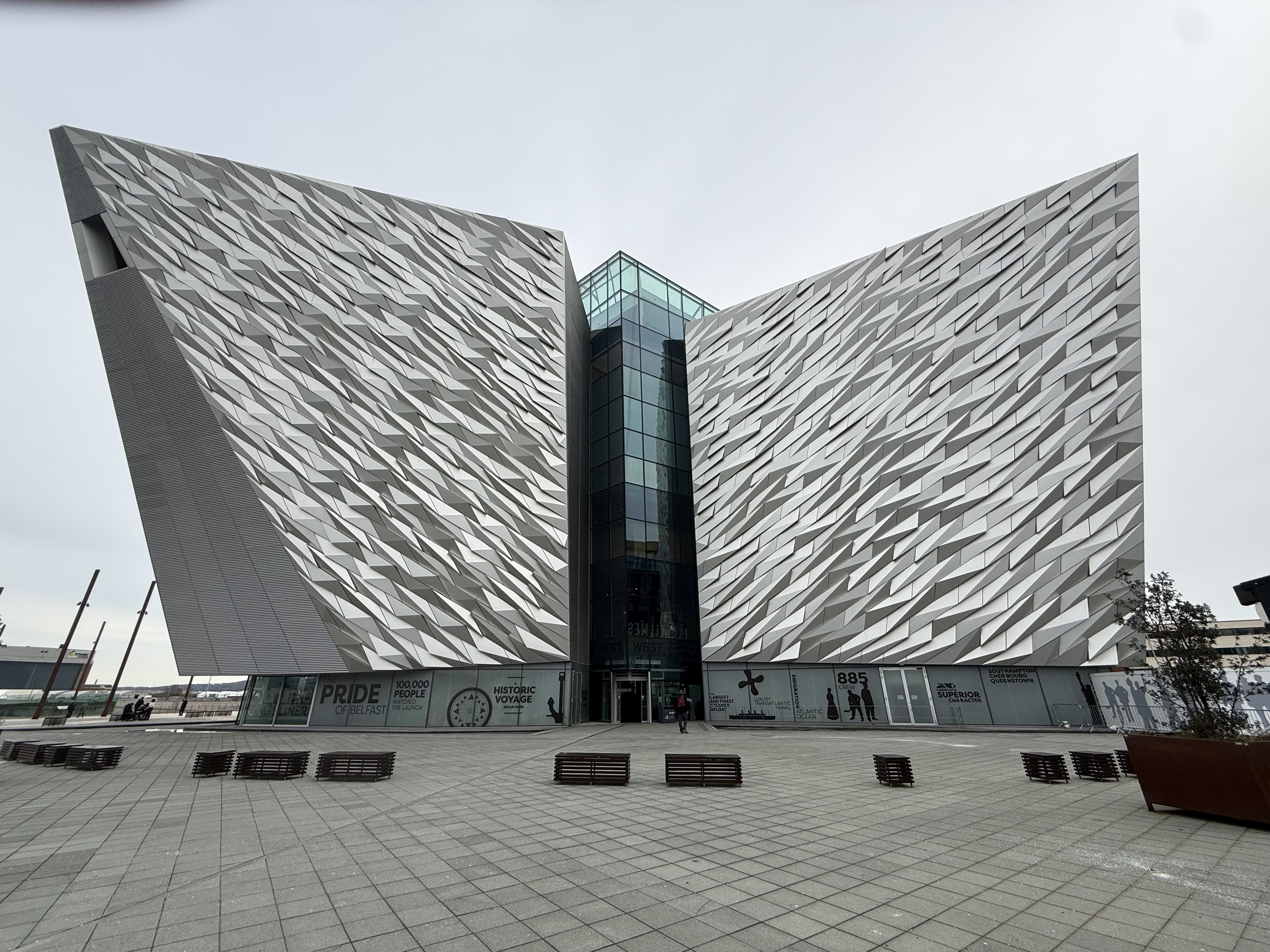
Because that’s what the first section of the museum is about. So now I know that Belfast was once nicknamed Linenpolis because it was the world’s largest producer of linen in the 1800s. I know that Belfast used to produce a quarter of the United Kingdom’s yearly ship building output. (Oh, hey, that’s why the Titanic was built there.) I know that a huge portion of the tobacco grown in the Southern US came back to Belfast, turned into cigarettes, cigars, and leaf tobacco by companies like Benson and Hedges and Silk Cut.
Then you transition into the actual building of the Titanic. Also fascinating; it was an insane feat of engineering. Those thousands of rivets that secure the hull were hand-hammered by thousands of workers slowly losing their hearing thanks to the ringing of hammers on steel. (Mostly Protestant workers; the shipyards were de facto segregated by religion.) There’s a small dark ride on the top floor that sort of takes you through a reconstruction of the yards, and I’m a sucker for those.
The next sections cover the launch, the interior of the ship — design, cabins, and such — and ultimately that ill-fated maiden voyage. Finally you reach the survivors and the aftermath. This wasn’t quite as interesting for me but the museum designers captured the solemnity of the sinking in a meaningful way. The huge lighted panel of names showing how the percentage of survivors was dramatically higher among the first class and wealthier passengers is well done.
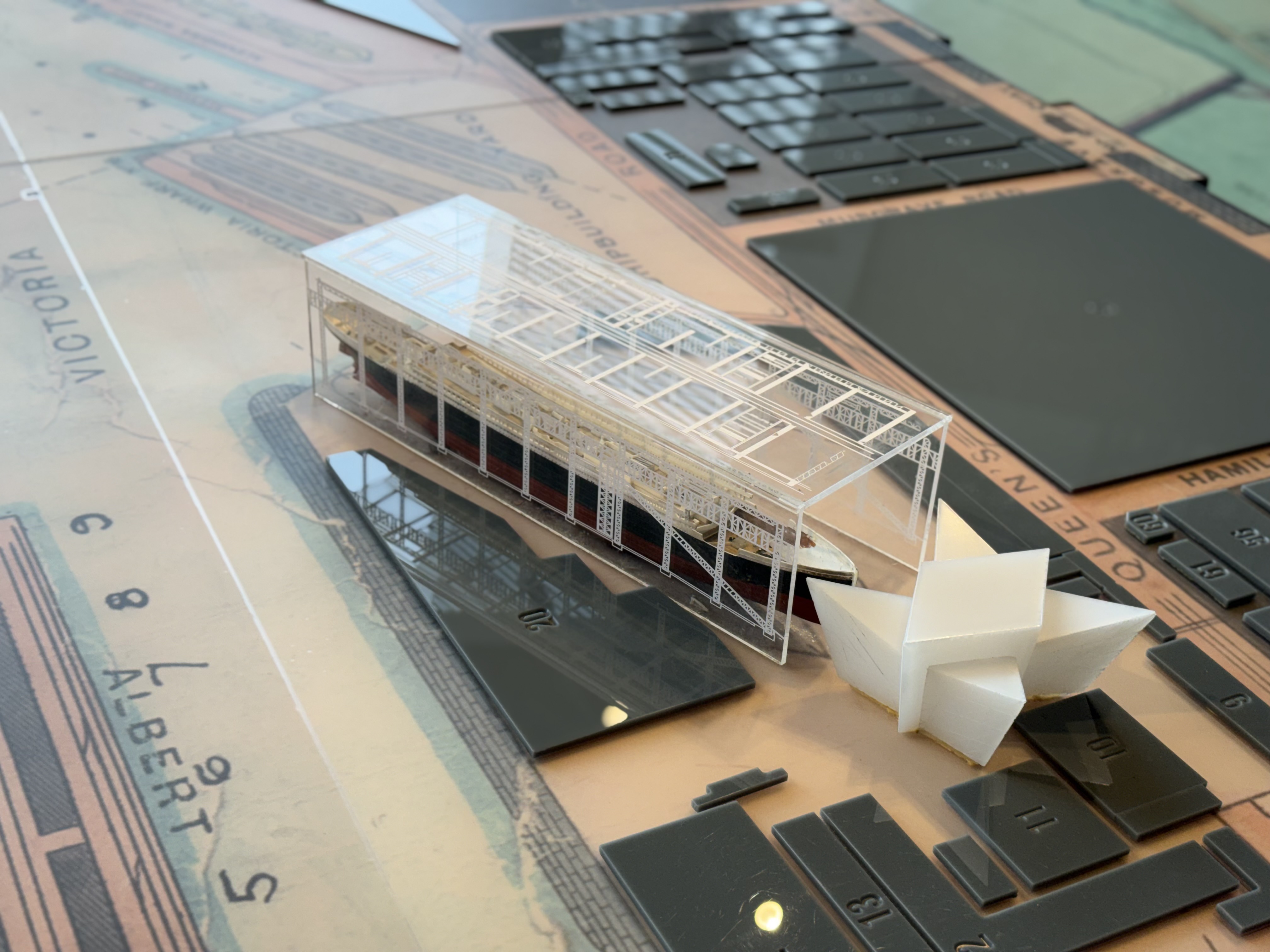
Backtracking a moment, the launch section was fairly neat from a scale perspective. The museum is a big building on the site of the old shipyard. The Titanic was built right next to the museum. You get a great view of the location of the slipway, and this neat scale model showing how big the ship was in comparison to the eight-story building.
So that was a decent way to wind up the tour before the bus ride back to Dublin. As I said, I’d very much like to go back to Belfast for a weekend or so, preferably not in winter, and figure out how to dig into the history more effectively. It made me think about how I explore cities, too.
I think the next time I’m in a new city, I want to make more of a point of visiting the local history resources. We’re going up to Vancouver soon — I’d like to see the Museum of Vancouver and learn about how the city sees itself. I don’t think there’s a city in the world that doesn’t have interesting history and prioritizing that a bit more rather than focusing on the aspects of the city I’m already excited about would do me well.
So yeah, that’s Belfast. Very meaningful trip. I appreciate that island so much, for all its beauty and flaws and bloody history and painful lessons and spirited ideals and passionate art. Man, it makes me sad we didn’t get to move there all over again.